Asteria Fleet Travel Simulator
Published on 2026-10-02 by Stuart Spence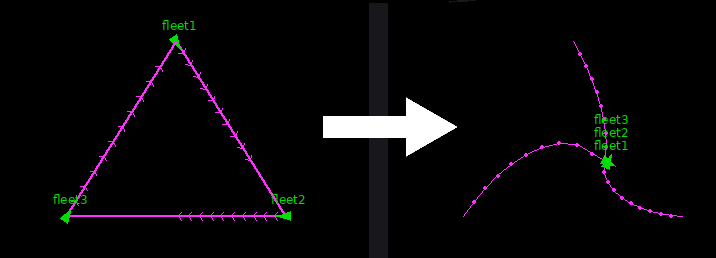
When playing a game like Stars! or Asteria it's easy to feel like fleet navigation rules are simple. Submit your orders where ships should go, click a button to generate the next turn, and ships end up closer to where they want to go. Simple.
Not really. Consider these three difficult scenarios.
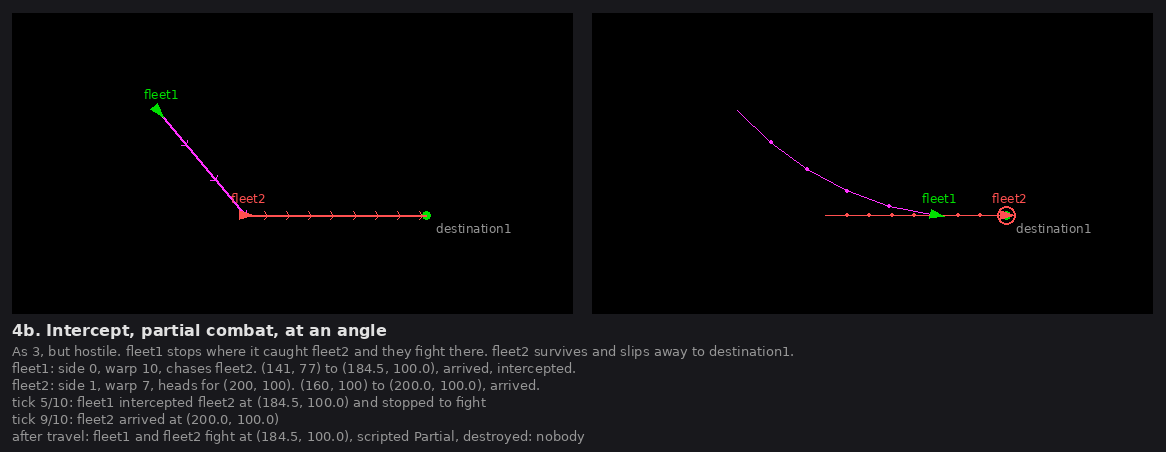
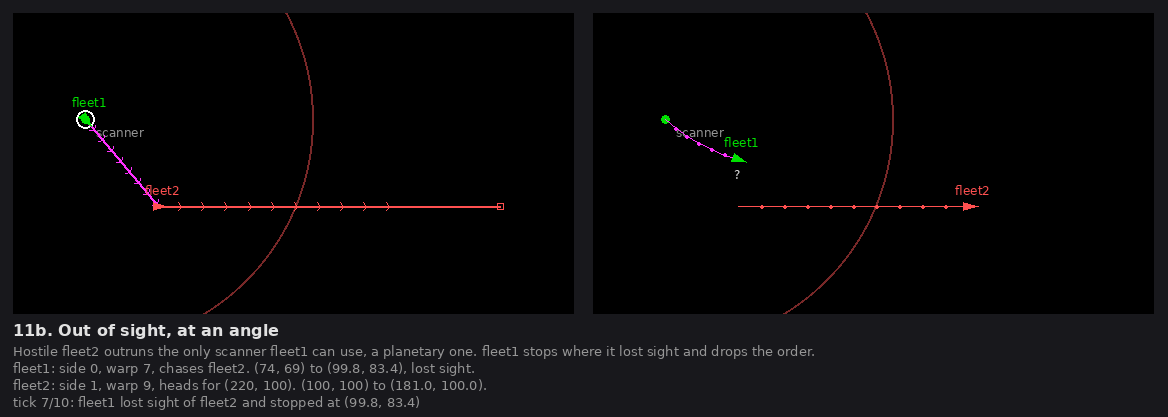
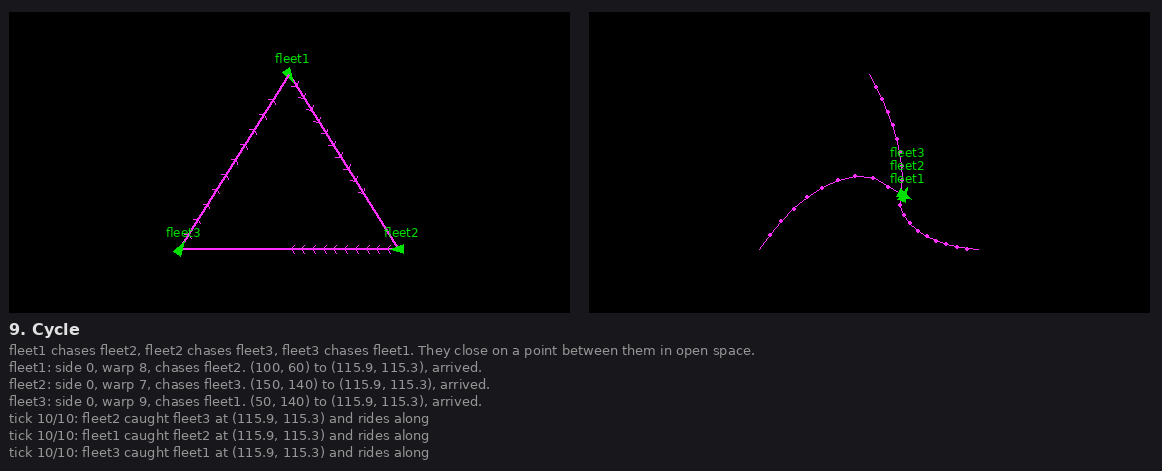
All diagrams on this page show turn 1 on the left with the intended travel of different fleets, and turn 2 on the right once they are resolved. What happens in between is an internal simulator hidden from the player. The player only sees the outcome.
Scenario 1: Intercept and partial combat
Fleet2 will make it to their destination in one turn, but Fleet1 is pursuing them and can intercept. Where's the battle? In deep space, or at the destination? If the battle is in deep space, but Fleet1 is only partially destroyed, does Fleet1 continue to its destination? Does Fleet2 follow it there, and is there a second battle there too?
Scenario 2: Out of sight
Fleet1 is pursuing Fleet2, but Fleet2 is faster and moves outside scanner range (and now cannot be seen). Does Fleet1 stop immediately? Continue to the last known position of Fleet2? Continue to where Fleet2 would have stopped if they continued going at that speed? What if 87% of Fleet2's travel gets them to a system / planet. Does Fleet1 guess that they stopped at the planet, or guess that they would have continued to use 100% of their speed in the direction to move through it?
Scenario 3: Cycle
We have a cycle. Fleet1 -> Fleet2 -> Fleet3 -> Fleet1. They all have different speeds. Can they all get to the same spot in one turn with their fuel and speed? Where do they meet?
The Plot Thickens
While working with AI to resolve one of these intercept issues, the AI started asking questions and proposing band-aid solutions that proved to me it had no plans for consistent and simple internal navigation rules. It seemed like the AI was just going to address bugs with different approaches for each edge case as they came up. Navigation would feel strange to the player in a "I can't quite put my finger on it" way, and this patchwork of rules would surely introduce more bugs.
So I brainstormed this list of 15 or so scenarios with starting conditions and my desired outcomes. There is no "right" answer to some of these scenarios - it's a question of game design, taste, and sticking to the Stars! feel. Then I came up with the concept to resolve 1 turn of movement by breaking it down into 10 segments, each with 1/10 of the movement budget each tick. Each fleet would try to get to its destination on its own terms and with its own knowledge of the target. The player doesn't see these 1/10 ticks, just the final outcome, but because it's a decent simulation underneath, those outcomes should feel about right.
I didn't just want the AI to politely promise it had implemented all of this. So I got the AI to generate these diagrams using the same code that the game itself would use to resolve navigation scenarios. End result: I got some really cool diagrams (cool enough to merit writing this blog post) and after a visual inspection I'm confident the new system is pretty good.
Full Report
Here's the full report if you're interested:

